


What Is The Difference Between M8 And M12 Connectors?
Choosing between M8 connector and M12 connectors seems simple, right? Yet, picking the wrong one can stall your automation project or cause frustrating failures down the line. Don't let connector choice be your system's weak point. We make the decision straightforward.
Pin Counts & Wiring: Configuration Options
Beyond just size, the real difference lies inside the connector. The number of pins dictates what kinds of signals or how much power the connector can handle.1 You wouldn't use a simple 3-pin connector for high-speed data, right?
M8 Connectors: Keeping with their compact nature, M8 connectors typically feature 3 or 4 pins.
● 3-Pin: Very common for basic sensors (like proximity or photoelectric sensors) needing power (positive, negative) and a single signal line. Simple and effective.
● 4-Pin: Offers flexibility for sensors needing an extra signal line or separate power pairs. You'll find these on many standard industrial sensors.
While less frequent, you might sometimes see M8s with 5 or even 6 pins for specific compact applications, but 3 and 4 are the mainstays.
M12 Connectors: The larger M12 body allows for more pins and more complex arrangements.2 Common counts include 3, 4, 5, 8, and 12 pins.
● 3 & 4-Pin: Similar uses to M8 (sensors, actuators) but in the more common M12 form factor.
● 5-Pin: Often used for CAN bus systems or devices needing an additional functional ground.
● 8-Pin: Frequently used for Industrial Ethernet protocols like EtherCAT or Profinet (supports 4 pairs).
● 12-Pin: Ideal for complex sensing or control applications needing many conductors in one connection point, like certain encoders or multi-function distribution boxes.
Why Coding Matters (A LOT):
You can't just jam any 4-pin M12 into any 4-pin socket. That's where coding (or keying) comes in. These are physical notches and tabs inside the connector interface that prevent you from mating connectors with different, incompatible wiring layouts. Think of it as a physical safety lock. Mixing up signal, power, or data lines could damage equipment. Definitely not good.
While a deep study of coding is for another time, common ones you'll see at Moco Connectors include:
● A-coded: The most common type for sensors, DC power, and actuators. (Available on m8 vs m12 connector)
● B-coded: Often used for Fieldbus connections like Profibus DP. (Mainly M12)3
● D-coded: Used for 100 Mbit Ethernet (Profinet, EtherNet/IP). Typically 4-pin. (Mainly M12)
● X-coded: Designed for high-speed 10 Gbit Ethernet. Always 8-pin. (Mainly m12 conector)
Electrical Ratings: Matching Voltage & Current
Connectors aren't just about fit; they need to handle the electrical load safely. Pushing too much voltage or current through a connector is asking for trouble – overheating, damage, or connection failure. You need to match the connector's ratings to your application's demands.
It's not one-size-fits-all. Electrical ratings depend heavily on the connector's specific design: pin count, pin size, coding, and even the wire gauge used play a part.
M8 Connector Ratings:
Generally, M8 connectors are used in lower-power circuits. You'll typically find them rated for voltages like 30V or 60V AC/DC. Current capacity per pin is often in the range of 1 Amp to 4 Amps, with lower values common for higher pin counts (more pins packed into the small space).
M12 Connector Ratings:
The larger M12 platform offers more electrical versatility. Standard M12 connectors (like A, B, D coded) might have ratings from 30V up to 250V AC/DC, depending on the pin count and specific standard. Current ratings per pin are frequently 1 Amp to 4 Amps, similar to M8 in many common sensor/actuator applications.
However, M12 truly expands with power-specific codings (like K, L, S, and T). These are designed explicitly for higher power delivery, potentially handling currents above 10 Amps and higher voltages. They use different pin arrangements and sizes to achieve this.
The Golden Rule:
Connector ratings can vary between manufacturers and specific product series. ALWAYS consult the datasheet for the exact connector part number you intend to use. Moco Connectors provides detailed datasheets for our M8 and M12 products, listing the precise voltage and current limits. Don't guess – verify the specs.
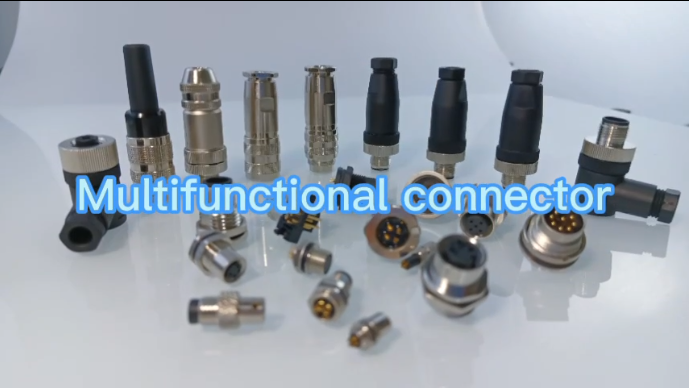
Typical Uses: Where Each Connector Type Shines
Knowing the size, pins, and electrical limits helps narrow things down. Now let's see where m8 vs m12 connector usually show up in the real world. While you might find some overlap, each type has its preferred applications.
M8 Connectors: Masters of Miniature
Think compact when you think M8. Its smaller size makes it the perfect fit anywhere space is tight, or the connected device is very small. You'll often find Moco Connectors' M8s used for:
● Miniature proximity sensors tucked into tight machine spaces.
● Small photoelectric sensors monitor objects on conveyors.
● Compact actuators or pneumatic valves need basic control signals.
● Some vision systems or scanners where the connector size is a limiting factor.
● Anywhere needing a reliable, basic I/O connection with minimal physical footprint.
M12 Connectors: The Industrial Mainstay
M12 is the well-established go-to connector for general industrial automation. Its slightly larger size and, critically, its wide range of pin counts and coding options allow it to handle diverse tasks. Our M12 connectors are regulars in applications like:
● Standard industrial sensors of all kinds (pressure, temperature, flow, position).
● Actuators, solenoid valves, and motor controls.
● Fieldbus networks, such as Profibus (using B-coding) or DeviceNet/CANopen (often A-coded 5-pin).
● Industrial Ethernet connections require specific D-coding (for 100 Mbit/s) or X-coding (for 10 Gbit/s).
● Dedicated power delivery using specialized K, L, S, or T codings for higher current needs.
● Connections to safety devices like light curtains or E-stops.
● Linking I/O points via distribution blocks or junction boxes.
The specific coding on an M12 often points directly to its job – D for data, B for bus, K/L/S/T for power. It's a smart system. Whether you need the compactness of M8 or the broad capability of M12, Moco Connectors provides reliable options for these applications.
Making The Right Choice: Key Factors
You've seen the differences in size, pins, electricals, and common uses. Now, how do you pick the right connector – M8 or M12 – for your specific job? It boils down to matching the connector's capabilities to your application's needs.
Ask yourself these key questions:
1. How much space do you have? If the connection point is extremely cramped or on a miniature device, the compact nature of M8 might be necessary. Otherwise, M12 is often easier to handle.
2. How many conductors are needed? Count the wires. Simple devices needing 3 or 4 conductors could use M8 or M12. For 5, 8, 12, or more pins required by complex sensors, Fieldbus, or Ethernet, you'll need an M12.
3. What are the voltage and current demands? Check the power requirements. Standard low-power signals are fine for M8 or common M12s. If you need higher voltage (up to 250V) or significantly higher current (above 4A), look specifically at power-rated conector m12 (K, L, S, T-coded).
4. What type of signal or network is it? The application often dictates the connector and coding. Industrial Ethernet requires M12 D-coded or X-coded. Profibus typically uses M12 B-coded. General sensors often use M8 or M12 A-coded. Check your device documentation.
5. Is there a preference for a standard interface? M12 is widely seen as the default industrial automation connector, offering broad compatibility. M8 fills the niche for miniaturization.
6. What's already in place? Sometimes, standardizing on one connector type within a machine or system simplifies inventory and maintenance. Consider your existing setup.
Both M8 and M12 connectors, like those from Moco Connectors, typically provide excellent environmental sealing (often IP67 or higher when correctly tightened), protecting against dust and water. So durability is usually solid for both in typical industrial settings.
The best first step is always to check the specifications of the device you are connecting. It will often recommend or require a specific connector type and coding. If you're still weighing the options or need a specific configuration, reach out to Moco Connectors. We have a wide range of M8 and M12 solutions and can help guide you to the perfect fit.
M8 or M12: Finding Your Fit
Choosing between M8 and M12 connectors doesn't need to be complicated. Remember the core idea: M8 excels in compact applications where space is limited, while M12 provides a versatile, standard platform for a huge range of industrial signals, data, and power needs.
The best connector always depends on the job. By considering the physical space, pin requirements, electrical load, and specific application (like Ethernet or Fieldbus), you can pinpoint the ideal match. Always start by checking your device's documentation.
Ready to explore high-quality connector options? Find a comprehensive selection of both M8 and M12 connectors designed for reliable performance right here at Moco Connectors.
Visit us to see the range: https://www.mococonnectors.com/
Making the informed choice means better system design and more dependable operation for your projects.

Shenzhen MOCO Interconnect Co., Ltd.
Become a world-class industrial connector supplier & manufacturer in China, MOCO Connectors providing reliable and convenient connector solutions for global customers
PRODUCTS
QUICK LINKS
If you have any question, please contact MOCO connectors.
TEL: +86 -134 1096 6347
WhatsApp: 86-13686431391
EMAIL: eric@mocosz.com
2/F 1st Block,XinHao Industrial Park,N.O 21 XinWei Rd,XinZhuang Community,MaTian, GuangMing District,Shenzhen,P.R.C