


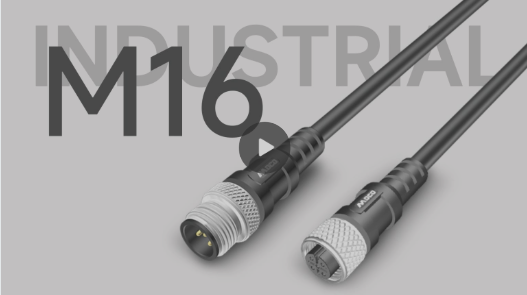
What is an M16 connector?1
Are you dealing with sensitive signals or harsh conditions? You need a connection that won't fail. Imagine a critical system where one loose wire could mean disaster. That's where M16 connectors come in. They provide secure, reliable connections for your most demanding applications. We'll show you what they are and why they are so vital.
M16 Connectors: What’s The Big Deal?
M16 connectors are a type of circular connector, defined by their M16 threading. That's a 16mm metric thread, for those keeping track. But it's not the size that makes them special. It's the secure connection they provide.
Think about it: a loose wire could bring a whole assembly line to a halt, wasting time and money. Our M16 connectors use a threaded design, which means they screw together for a tight, reliable fit that won't vibrate loose. This robust design provides several key benefits you'll appreciate.
The Big Advantages
We see M16 connectors used everywhere because they simply perform well under pressure. Here are a few reasons we've heard from clients that keep them coming back for more:
● Extreme Durability: These connectors are built to last. Many are made from metals like brass or stainless steel, which protect the internal components from harsh conditions like high temperatures, dust, and moisture. In fact, many M16 connectors carry an IP67 or IP68 rating, meaning they can withstand temporary or even continuous submersion in water.
● Reliable Performance: The screw-locking mechanism gives you a super-secure connection. This is huge in applications with a lot of vibration, like robotics or heavy machinery. You won't have to worry about an accidental disconnect.
● Versatility: M16 connectors are not just for power. They can be configured with different pin counts to transmit signals, data, or a mix of both. This flexibility makes them a solid choice for everything from sensors to actuators.
● EMI Shielding: Many M16 connectors offer electromagnetic interference (EMI) shielding. This is a must-have if you're working with sensitive signals, as it protects your connection from outside noise that could corrupt data or cause system errors.
Types Of M16 Connectors & Their Uses
You'll find M16 connectors in a couple of main varieties, each serving a specific purpose. Knowing the difference helps you choose the right one for your job, whether you're working with power, data, or both.
Power & Signal Connectors
These are the most common types. You'll see them with different numbers of pins, from m16 connector 2 pin up to m16 connector 12 pin or more. The number of pins you need depends on your application. For example, a m16 3 pin connector might be used for simple power, while a 7-pin or 8-pin version is great for transmitting multiple signals at once.
● Industrial Automation: Robots, sensors, and actuators all need reliable connections. M16 connectors handle both the power to run the machine and the signals to control it.
● Medical Equipment: From diagnostic devices to monitoring systems, medical gear needs dependable, secure connections. M16 connectors provide just that.
● Outdoor Lighting: Think streetlights or landscape lighting. These connectors are often sealed to protect against rain and dust, making them perfect for outdoor use.
Data Connectors
Some M16 connectors are specifically designed for data transmission, like Ethernet. These often have a specific pin layout to meet standards like CAT5e or CAT6.
● Ethernet in harsh environments: If you need a network connection on a factory floor, a regular RJ45 cable won't cut it. An M16 data connector provides a sealed, secure connection that resists dust and vibration.
● Fieldbus Systems: These connectors are used for communication between different devices in an automated system, ensuring everything works together seamlessly.
Selecting The Right M16 Connector
Picking the right M16 connector isn't a shot in the dark. You need to consider a few key factors to ensure a perfect fit for your application. We've seen people make the wrong choice, and it always ends up costing them time and money. Here is our simple checklist to help you make the right choice the first time.
Pin Count & Configuration
First, figure out how many pins you need. This depends on the number of wires and signals you plan to transmit. M16 connectors come in various pin counts, from 2 to 12 or more. Make sure you have enough pins for power, ground, and all of your data signals. You also need to decide on the configuration—is it a male or female connector? A straight or angled body?
IP Rating: Protection from the Elements
The IP (Ingress Protection) rating tells you how well the connector protects against solids and liquids. This is a big deal. For example, an IP67 rating means the connector is dust-tight and can handle temporary immersion in water. An IP68 rating means it's suitable for continuous submersion.
● IP65: Protected against water jets. Good for wet environments, but not submersion.
● IP67: Dust-tight and protected against temporary submersion (up to 1 meter for 30 minutes). Perfect for outdoor use.
● IP68: Dust-tight and protected against continuous submersion. Use this for underwater or extremely wet applications.
Shielding for EMI/RFI
If your application involves sensitive signals, you need shielding. Electromagnetic interference (EMI) and radio-frequency interference (RFI) can corrupt data and cause your system to fail. A shielded connector has a metal housing that blocks out this noise.
● Unshielded: Fine for basic power and non-sensitive signals.
● Shielded: A must for data and sensor signals, especially when running near motors or other sources of interference.
Mounting Type
How will you attach the connector? M16 waterproof connectors are available in different mounting styles, including panel mount, cable mount, and PCB mount.
● Panel Mount: Sits on a control panel or enclosure.
● Cable Mount: Connects to the end of a cable.
● PCB Mount: Solders directly onto a printed circuit board.
Tips For Installation And Maintenance
You've picked the right connector. Now what? Correct installation and simple maintenance go a long way toward ensuring your connection lasts. A sloppy install can ruin a good connector, no matter how tough it is.
Installation: Do It Right the First Time
A good installation is about precision. It's not difficult, but it requires attention to detail.
1. Prep the Cable: Strip the cable jacket and individual wire insulation to the lengths specified in the connector's data sheet. Don't eyeball it. A wrong length can lead to a weak connection.
2. Crimp, Don't Solder: Use a proper crimping tool for a gas-tight, reliable connection. This is way better than soldering, which can fail under vibration or thermal stress. We recommend using the crimp tool specified by the industrial connector manufacturer.
3. Secure the Gland Nut: The cable gland nut on the connector tightens around the cable jacket, providing strain relief and maintaining the IP rating. Tighten it securely, but don't overtighten it. You could damage the cable or the seal.
Simple Maintenance to Keep Things Running
M16 connectors are low-maintenance, but a quick check can prevent big problems down the line.
● Regular Visual Inspection: Look for any signs of damage to the outer housing, like cracks or dents. Check the O-rings and seals to make sure they're not cracked or dry.
● Keep It Clean: If the connector is in a dusty or dirty environment, wipe it down. Dirt and grit can get into the threads and make it hard to connect. A quick wipe with a clean cloth is all it takes.
● Torque Check: Periodically check the tightness of the screw-locking mechanism. Vibration can cause it to loosen over time. A simple twist by hand is usually enough to confirm it's still secure.
M16 Vs. Other Circular Connectors
You've probably seen other circular connectors out there, like M8s and M12s. So, what makes the M16 different? It's all about finding the right tool for the job. While they might look similar, M16 connectors have distinct advantages that set them apart.
Size and Pin Count
The most obvious difference is size. The 'M' number refers to the metric thread size.
● M8 connectors are tiny, typically used for small sensors and actuators in tight spaces. They usually have a lower pin count, from 2 to 5 pins.
● M12 connectors are the industry standard for a lot of automation. They are a good middle ground for sensors, fieldbuses, and industrial Ethernet, offering up to 12 pins.
● M16 connectors are larger. This size allows for higher pin counts, often up to 24 pins, and can handle higher current loads. They are often a better fit for power and data combos or complex signal configurations.
Performance and Use Cases
M16 connectors are often the go-to for more demanding applications.
● Higher Current: Because of their larger size, M16s can handle more electrical current than their smaller counterparts. This makes them ideal for power applications where M8s or M12s would be inadequate.
● Data and Power in One: Many M16 connectors are designed to carry both power and signals in the same body. This is a big win for simplifying wiring and reducing clutter. You'll often see this in robotics or machine building.
● Robustness: The larger size and secure screw-locking mechanism often give M16 connectors an edge in terms of durability. They can withstand more physical stress and vibration.
Final Thoughts On M16 Connectors
M16 connectors are more than just a component; they're a foundation for reliable systems. We've walked through what makes them special, from their durability to their versatility. They're a smart choice for applications where you can't afford a failure. By choosing the right type, considering the environment, and installing it correctly, you ensure a connection that's built to last.
To explore our full range of M16 connectors, you can visit our website. Our team is always ready to help you find the perfect solution for your specific needs. You can browse all of our products at https://www.mococonnectors.com/.

Shenzhen MOCO Interconnect Co., Ltd.
Become a world-class industrial connector supplier & manufacturer in China, MOCO Connectors providing reliable and convenient connector solutions for global customers
PRODUCTS
QUICK LINKS
If you have any question, please contact MOCO connectors.
TEL: +86 -134 1096 6347
WhatsApp: 86-13686431391
EMAIL: eric@mocosz.com
2/F 1st Block,XinHao Industrial Park,N.O 21 XinWei Rd,XinZhuang Community,MaTian, GuangMing District,Shenzhen,P.R.C